
What Is Motivational Interviewing?

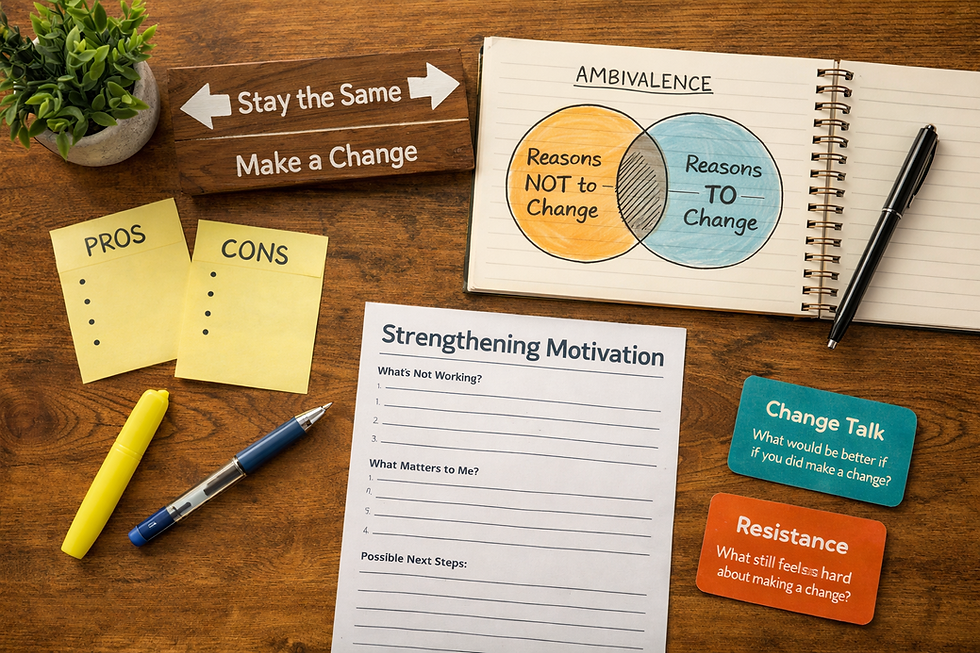
A lot of people come to therapy feeling conflicted.
Part of them wants something to change. Another part feels unsure, resistant, tired, scared, or not fully ready. That does not mean they do not care. It usually means the situation is more complicated than it looks from the outside.
That is where Motivational Interviewing can be especially helpful.
Motivational Interviewing is a therapy approach that helps people work through ambivalence and strengthen their own reasons for change. It is often used in addiction treatment, but it can also be helpful any time someone feels stuck between knowing something is not working and not feeling fully ready to do something different.
This approach is not about convincing, confronting, or pressuring someone into change. It is about helping people hear themselves more clearly, connect with what matters to them, and build motivation from the inside out.
What motivational interviewing means
Motivational Interviewing, often called MI, is a collaborative, person-centered approach that helps people explore mixed feelings about change.
Ambivalence is a normal part of change. People often have good reasons for wanting something to be different, and also good reasons for feeling hesitant.
For example:
Someone may want to stop drinking, but feel afraid of losing the one thing that helps them cope.
Someone may want to stop gambling, but still feel pulled toward the hope, excitement, or escape it provides.
Someone may want better boundaries, but fear disappointing people.
Someone may want to take better care of their mental health, but feel overwhelmed by where to start.
MI creates space for those mixed feelings without turning therapy into a power struggle.
Why change is often complicated
People are often hard on themselves for feeling stuck.
They say things like:
“I know what I need to do, so why can’t I just do it?”
“Part of me wants to change, but part of me really doesn’t.”
“I’m tired of repeating the same cycle.”
“I want things to be different, but I don’t trust myself.”
That internal conflict is not a sign of failure. It is often a sign that change matters and carries real emotional weight.
Most patterns, even harmful ones, serve some kind of purpose. They may reduce distress, numb pain, create relief, offer structure, or help someone avoid something even harder. That is why change can feel both necessary and threatening at the same time.
Motivational Interviewing helps people get honest about both sides of that conflict.
How motivational interviewing works
MI is built around the idea that lasting change is usually stronger when it comes from a person’s own values, goals, and internal motivation rather than outside pressure.
Instead of arguing with resistance, MI helps explore it.
Instead of telling someone why they should change, MI helps them talk through:
what is not working
what they want to be different
what matters to them
what is getting in the way
what makes change feel hard
what small step feels possible right now
A lot of this process involves listening for what is sometimes called change talk. That means the person begins identifying their own reasons, desire, ability, or need for change.
That matters because people are often more likely to move when they hear their own truth clearly, not when someone lectures them.
What motivational interviewing can help with
Motivational Interviewing can be helpful for:
addiction and recovery
relapse patterns
behavior change
ambivalence about treatment
resistance or shutdown
anxiety about making decisions
lifestyle changes
setting boundaries
building momentum
reconnecting with values
It can be especially useful when someone feels stuck between insight and action.
What it feels like in therapy
Motivational Interviewing tends to feel different from therapy approaches that are more directive.
A good MI process often feels:
collaborative
curious
respectful
nonjudgmental
less pushy
more honest
focused on your own reasons for change
It is not passive, but it is also not about someone telling you what to do.
For many people, MI feels relieving because it lowers shame and defensiveness. It allows people to be honest about not being ready, not being sure, or feeling pulled in different directions without that becoming a failure.
That honesty often becomes the starting point for real movement.
How I use motivational interviewing
In my practice, I use Motivational Interviewing to help clients explore ambivalence, reduce shame, and connect more clearly with what they want for themselves.
This can be especially helpful for clients navigating:
substance use
gambling behaviors
relapse vulnerability
emotional avoidance
resistance around treatment
difficulty following through with change
feeling torn between comfort and growth
I often use MI alongside other approaches depending on the person’s needs, including CBT, DBT, trauma-informed care, and values-based work.
For many clients, MI helps shift therapy away from self-judgment and toward more honest reflection, internal motivation, and meaningful next steps.
When motivational interviewing may be a good fit
Motivational Interviewing may be a good fit if you:
feel stuck in a pattern you know is not helping
feel conflicted about making a change
want support without being judged or pushed
struggle with follow-through even when you have insight
go back and forth between wanting change and avoiding it
need help reconnecting with your own reasons for doing things differently
If you are in Massachusetts and looking for therapy support for addiction, gambling, anxiety, trauma, depression, or other patterns that feel difficult to shift alone, you can learn more about my services or reach out to schedule a consultation.


Comments